Plant Disease Classification
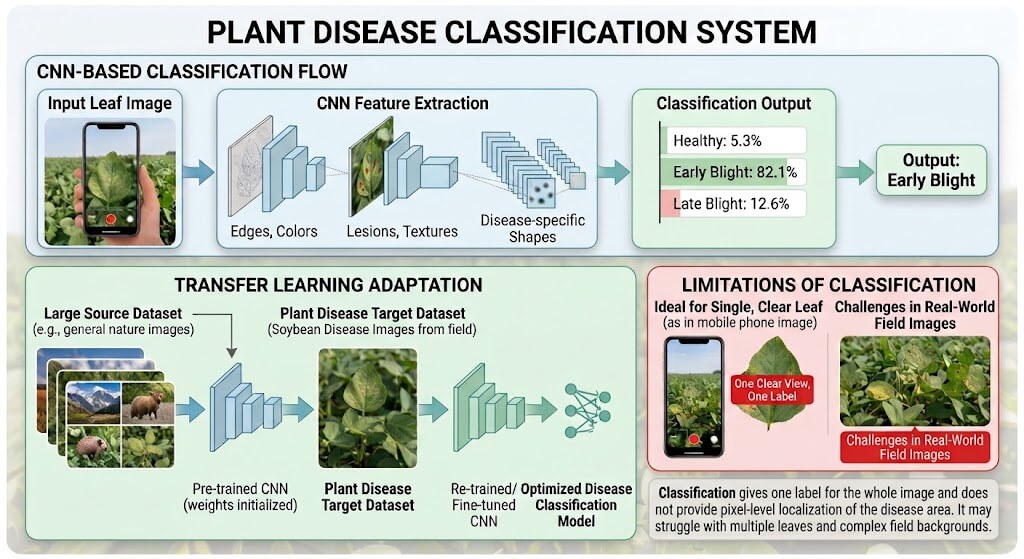
Image classification assigns an entire leaf photo to a single category, such as Healthy, Early Blight, Late Blight, or Leaf Spot. In modern computer vision, Convolutional Neural Networks (CNNs) are the standard choice because they automatically learn visual patterns from training images [1], [2].
How CNNs Learn Disease Patterns
A CNN processes the image through multiple convolutional layers:
- Early layers: Learn simple patterns like lines, edges, and color changes along leaf borders.
- Middle layers: Combine edges into textures and shapes, recognizing spots, lesions, and concentric rings.
- Deep layers: Detect complex disease symptoms across the leaf surface.
- Softmax layer: Converts final feature numbers into probabilities for each disease class: $$P(y = k \mid \mathbf{x}) = \frac{e^{z_k}}{\sum_{j=1}^{K} e^{z_j}}$$
Transfer Learning
Training a deep CNN from scratch requires thousands of labeled images. In agriculture, collecting huge datasets of rare diseases is difficult and expensive. Transfer learning solves this by starting with a model already trained on a large dataset (like ImageNet) and fine-tuning it on plant disease images [2]. This speeds up training and achieves good accuracy even with smaller datasets.
Limitations of Classification
While classification is straightforward to set up, it has important limitations when used in real fields:
- No location information: It gives only one label for the whole image and cannot point to where the disease is.
- Multiple leaves: In field photos with several leaves—some healthy, some sick—classification is forced to pick just one label.
- Background confusion: The model can mistakenly rely on soil color or background weeds instead of the leaf itself.
Why Classification Is Still Useful
Despite these limitations, classification is still useful:
- It is fast and requires less computing power than detection or segmentation.
- It works well as a quick initial filter before running more complex models.
Module Narration
A 1–2 minute audio explanation of CNN classification, transfer learning, and localization limits.