Mobile and Edge Deployment
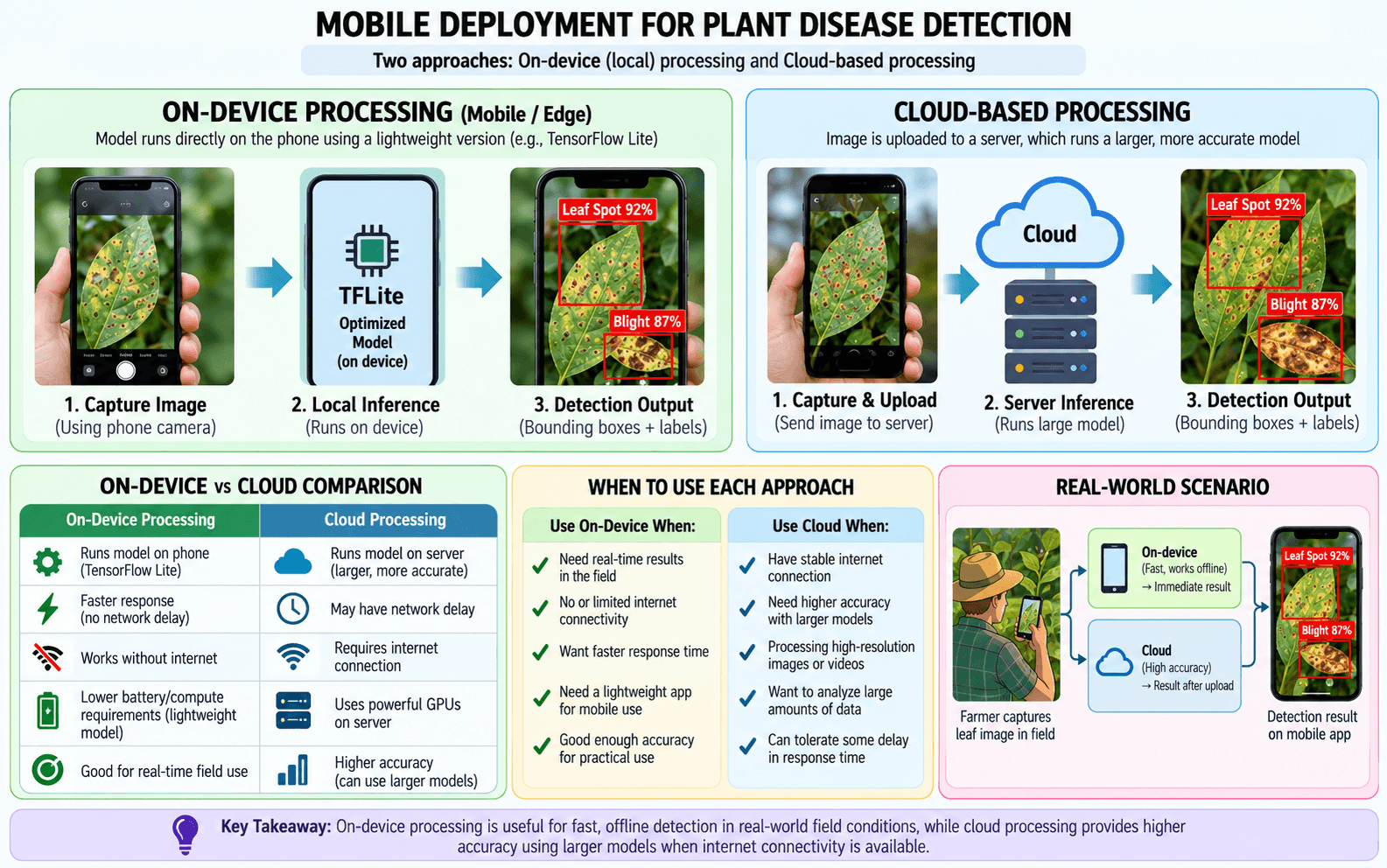
To make plant disease detection useful for farmers and agronomists, the vision model must run reliably in field conditions. In rural agricultural areas, internet connections can be weak or unavailable. System designers choose between two main architectures [2]:
On-Device (Edge) Processing
The model runs directly on the smartphone or edge processor (such as an embedded GPU on an agricultural robot).
- Pros: Immediate predictions (no network delay), works offline in remote fields, and protects image privacy.
- Cons: Limited memory and battery, phone heating during continuous video processing, and constraints on model size.
Cloud-Based Processing
The phone captures images or video and sends them to a remote cloud server for processing.
- Pros: Can run larger, high-accuracy models without draining mobile battery.
- Cons: Requires reliable cellular or Wi-Fi connectivity, uses data bandwidth, and introduces upload latency.
Lightweight Models and Optimization
For on-device mobile use, lightweight models such as MobileNet and small YOLO variants are preferred. These architectures use depthwise separable convolutions to significantly reduce computation and parameter count with minimal drop in accuracy [2]. Techniques such as INT8 quantization also lower memory usage and speed up mobile inference.
Evaluation Metrics
Different computer vision tasks require specific evaluation metrics:
1. Classification Metrics
- Accuracy: $\frac{TP + TN}{TP + TN + FP + FN}$ — Overall percentage of correct predictions.
- Precision: $\frac{TP}{TP + FP}$ — How many predicted disease cases are actually diseased.
- Recall (Sensitivity): $\frac{TP}{TP + FN}$ — How many actual diseased leaves were successfully detected.
- F1-Score: $\frac{2 \cdot \text{Precision} \cdot \text{Recall}}{\text{Precision} + \text{Recall}}$ — Harmonic mean balancing precision and recall.
2. Object Detection Metrics
- IoU (Intersection over Union): $\frac{\text{Area of Overlap}}{\text{Area of Union}}$ between predicted box and ground-truth box.
- mAP@0.5: Mean Average Precision evaluated at an IoU threshold of 0.50.
- mAP@0.5:0.95: Average mAP across 10 IoU thresholds from 0.50 to 0.95.
3. Segmentation Metrics
- Pixel IoU: Overlap between predicted lesion pixels and ground-truth mask.
- Dice Score: Similar to IoU; it also measures pixel-level mask overlap.
4. Operational Speed
- Inference Latency: Time in milliseconds to process one frame.
- Frames Per Second (FPS): Real-time video generally requires roughly 30 FPS.
Real-World Challenges
Real-world agricultural conditions present several practical difficulties:
- Lighting changes: Direct sun, shadows, and overcast skies change leaf color and hide symptoms.
- Background clutter: Soil, weeds, and nearby leaves can confuse detectors.
- Occlusion: Leaves often overlap, hiding diseased spots.
- Similar symptoms: Different diseases can produce very similar yellowing or brown spots.
- Motion blur: Phone movement or wind can blur high-frequency lesion textures.
Researcher Interview Request
To learn more about the practical challenges of video monitoring, I contacted Professor Shinjiro Umezu of Waseda University, co-author of the Plant Doctor paper [5].
Contacted: Professor Shinjiro Umezu (Faculty of Science and Engineering, Waseda University, Tokyo, Japan)
Questions Sent:
- Damage Segmentation: “Your segmentation model achieved high IoU for leaves (0.96) but lower IoU for damaged regions (0.76). What do you think is the main reason for this difference, and how could damage segmentation be improved?”
- Video Processing Speed: “Video processing currently takes much longer than real time (approx. 50 minutes for a 1-minute video). Do you see a realistic path toward running a system like Plant Doctor on a smartphone or drone in real time?”
- Field Challenges: “What do you think is the biggest challenge for plant disease detection in real-world environments today: limited data, lighting and complex backgrounds, or computational requirements?”
Interview request sent to Professor Shinjiro Umezu. Response pending.
Research Labs and Groups
Several active research groups are combining computer vision with agriculture:
Umezu Laboratory • Waseda University
The research group led by Prof. Shinjiro Umezu works on bioengineering, sensing, and plant-monitoring systems. The group developed the Plant Doctor system [5], exploring how video footage, YOLO detection, and segmentation can be used for non-invasive urban plant health monitoring.
Precision Agriculture Laboratory • University of Florida
Led by Dr. Yiannis Ampatzidis (co-author of the feature engineering survey [3]), this lab works on artificial intelligence, drone imaging, and smartphone apps for disease detection in citrus, tomato, and strawberry crops.
Future Research Directions
Key directions for future work include:
- Vision Transformers: Exploring transformer backbones for better feature attention in complex canopies [1].
- Multi-Modal Imaging: Combining regular RGB cameras with near-infrared or thermal imaging to detect infection before symptoms become visible.
- Larger Field Datasets: Gathering training images across more crops, geographic locations, and disease stages.
Conclusion
Computer vision can help with plant disease detection using mobile cameras and video. Classification provides a quick initial diagnosis, object detection finds individual leaves, and segmentation allows us to measure disease severity accurately.
Using video gives the model multiple views of the same plant, helping overcome lighting and camera angle problems. While real-time video processing remains a challenge on mobile devices, combining efficient models, tracking, and multi-frame analysis is an important direction for practical agricultural tools.
Quick Knowledge Check
Test your understanding of the concepts covered in this tutorial:
Module Narration
A 1–2 minute audio walkthrough of edge vs cloud deployment, interview insights, and future research.